
There was a time when I used to explain SEO by saying, “Get good backlinks, optimize your keywords, improve your Meta Tags and make sure Google can crawl your website.”
And honestly, that worked.
Then came the era of Penguin and Panda, which outdated the concept of creating backlinks. Then came the importance of content quality, user experience, mobile optimization, Core Web Vitals, search intent, E-E-A-T and so many other things.
And now, in 2026, we are standing at another interesting point in the history of digital marketing.
Search is changing again.
But this time the change is much bigger.
People are not only searching on Google and clicking on the first ten blue links. They are asking questions to AI systems. They are expecting direct answers. They are comparing products, services and businesses through conversational interfaces. Google itself has introduced AI-powered experiences such as AI Overviews and AI Mode, while the broader search ecosystem is increasingly influenced by generative AI.
So, should we forget SEO?
Absolutely not!
In fact, I would say that SEO is becoming even more important, but the way we think about SEO needs to change.
I have been watching the SEO industry evolve for more than two decades. I have seen the days when directory submissions were considered important, when link building was one of the biggest priorities, when people used to create pages almost entirely around keywords, when people use to submit the same article to around hundreds of websites and when ranking at number one on Google was considered the ultimate achievement.
Today, things are different.
Or perhaps I should say:
The game is different, but the objective remains the same – be found by the right audience and give them a reason to trust you.
This is where SEO, AEO and GEO come together.
So, in this blog post, let us understand what we should actually consider while doing SEO, AEO and GEO in 2026 and ahead.
First of All, What Are SEO, AEO and GEO?
Before we go any further, let us understand these three terms in simple language.
SEO – Search Engine Optimization
SEO is about making your website and its content easier for search engines to discover, understand and rank, and not only that, but to improve the user experience as well.
Traditionally, we focused heavily on:
- Keywords
- Meta Titles
- Meta Descriptions
- Heading Tags
- Internal Linking
- Backlinks
- Technical SEO
- Website Speed
- Mobile Friendliness
- Content Optimization
- Crawlability
- Indexability
These things are pretty basic, but still important.
But SEO today is no longer just about inserting a keyword ten times into an article.
It is about understanding what the user wants and whether your content genuinely satisfies that need.
Google’s current guidance continues to emphasize helpful, reliable and people-first content rather than content created primarily to manipulate rankings.
AEO – Answer Engine Optimization
AEO stands for Answer Engine Optimization.
The idea is simple.
Instead of only asking:
“How can I rank this page?”
we should also ask:
“How can my content become the best possible answer to a question?”
People are increasingly asking complete questions instead of typing two or three keywords.
For example:
Old search behavior:
“best SEO strategy 2026”
Conversational search behavior:
“What should a small business do to improve its SEO in 2026?”
These are two different ways of expressing almost the same requirement.
AEO focuses on making your content easy for systems to understand and extract useful answers from. To be honest, but it was late 2012 only when I start asking my teams to focus on such questions and long-tail keywords.
That means clear questions, clear answers, logical structure, useful explanations, factual accuracy and strong topical relevance.
GEO – Generative Engine Optimization
GEO generally refers to Generative Engine Optimization.
This is about improving the likelihood that your brand, website, expertise, products or information are discovered, understood and potentially referenced within generative AI experiences.
Think about the difference.
SEO asks:
“Can I rank for this query?”
AEO asks:
“Can I provide the best answer?”
GEO asks:
“Can AI systems understand my expertise and recognize my content as a useful source when generating an answer?”
The three are different, but they are increasingly interconnected.
And here is the interesting part.
You don’t necessarily need three completely different strategies.
A strong foundation can support all three. And in my honest opinion SEO does the same, build a strong foundation for your website.
1. Stop Writing for Google. Start Writing for People.
This is perhaps the most important point I want to make. I remember the days when SEO professionals would carefully calculate keyword density.
“Should I use the keyword 5 times?”
“Should it be 2%?”
“Should it be in the first paragraph?” (The best of my approach, you can see most of these into some of my past blogs related to SEO and Blogging Tips)
“Should I create another page for the plural version?”
We have come a long way since then.
Today, if you write an article that sounds as though it was created only because you wanted to rank for a keyword, your reader will notice it.
And increasingly, search systems are becoming better at understanding this too.
Google’s current documentation repeatedly emphasizes people-first content and asks creators whether their content provides original information, substantial value, insightful analysis and a satisfying experience.
So before writing an article, ask yourself:
Would I still write this article if Google did not exist?
If the answer is yes, you are probably moving in the right direction.
2. Understand Search Intent Much Better
Keywords are still important. But search intent is more important.
Suppose somebody searches:
“SEO agency Delhi.”
They might want to hire an agency.
Another person searches:
“How does SEO work?”
They probably want education.
Someone else searches:
“SEO audit checklist.”
They may want a practical resource.
And another person might ask:
“Why did my Google rankings suddenly drop?”
They have a problem and want a solution. The best approach for blogging is to provide solutions to the real-life problems of the users, you can also check why blogging is important in our life?
The keyword may be related to SEO in all four cases.
But the intent is completely different.
This is why I believe that keyword research in 2026 should become more human.
Don’t just collect keywords.
Understand the questions, problems, comparisons, doubts, objections and decisions behind those keywords.
That is where SEO starts becoming AEO. And that is also where GEO becomes interesting.
3. Think in Topics, Not Just Keywords
One of the biggest mistakes I see is that people still create one page for one keyword.
SEO has moved beyond that.
If you are writing about “SEO for small businesses,” you should naturally be able to discuss:
- Keyword research
- Local SEO
- Technical SEO
- Content strategy
- Internal linking
- Reviews
- Business profiles
- Conversion optimization
- Search intent
- AI search
- AEO
- GEO
- Analytics
- Measuring results
Why?
Because a real expert would naturally understand the subject as a connected ecosystem.
Search engines and AI systems are increasingly capable of understanding relationships between concepts.
So instead of creating dozens of thin pages around individual keywords, create deep topical authority.
One excellent pillar article can be more valuable than twenty mediocre keyword-focused articles.
4. Make Your Content Answer Questions Clearly
This is where AEO becomes extremely important.
Imagine that someone asks:
“What is AEO?”
Don’t spend 500 words building suspense.
Give the answer.
Something like:
AEO, or Answer Engine Optimization, is the process of structuring and improving online content so that answer-oriented search experiences can understand, extract and present the information effectively.
Then explain it.
This simple approach makes your content useful to humans and machine systems alike.
Use headings such as:
- What is SEO?
- What is AEO?
- What is GEO?
- Why is AEO important?
- How does GEO work?
- What is the difference between SEO and GEO?
- How can businesses prepare for AI search?
Questions naturally create a structure that works well for conversational search.
5. Don’t Forget the Traditional SEO Fundamentals
Here is something I find fascinating about 2026. We are talking about AI, generative search, agents, AEO and GEO.
But many websites still have:
- Broken internal links and I accept my blogs too have a few of them
- Slow pages
- Poor navigation
- Incorrect canonical tags
- Indexing problems
- Duplicate pages
- Missing alt text
- Poor mobile experience
- Unoptimized images
- Weak internal linking
- Pages blocked accidentally from crawlers
Sometimes we become so fascinated by the future that we forget the basics.
Google’s current guidance for AI features makes this very clear: pages still need to be crawlable, indexable and eligible for normal Search, and the traditional SEO fundamentals continue to matter.
So yes, learn GEO. Yes, understand AEO.
But please don’t forget your sitemap!
6. Technical SEO Is Still Alive and Kicking
I know that “Technical SEO” doesn’t sound as exciting as “Generative AI.”
But it remains essential.
Make sure:
- Googlebot can access your important pages.
- Important pages are indexable.
- Robots.txt isn’t accidentally blocking critical resources. And more focus towards llms.txt & ai.txt.
- Your XML sitemap is healthy.
- Canonical tags are correctly implemented.
- Redirects are properly configured.
- Your website works well on mobile.
- JavaScript doesn’t hide important content from search engines.
- Pages load efficiently.
- Your internal linking structure makes sense.
- Duplicate content is controlled.
Google’s latest generative AI guidance specifically says that technical clarity remains foundational because AI search experiences depend on the same underlying discovery and indexing systems.
So, in my opinion:
Technical SEO is not becoming less important. It is becoming invisible—but critical.
The basic principles and building blocks for the businesses should be: When it works, nobody notices. When it doesn’t, everyone notices.
7. Write Content That Demonstrates Experience
This is one area where I believe human writers still have an enormous advantage.
AI can summarize.
AI can explain.
AI can combine information.
AI can produce thousands of words.
But your experience is yours.
Suppose you are writing about digital marketing.
Don’t just tell readers what SEO is. Tell them what you have actually experienced, just like I do in my blogs.
Talk about:
- Campaigns you worked on.
- Mistakes you made.
- Strategies that failed.
- Strategies that worked.
- Changes you observed.
- Lessons you learned.
- Things you would do differently today.
That makes the content more authentic.
Google’s guidance encourages content that demonstrates first-hand expertise and makes authorship and expertise clear.
This is where I personally see a huge opportunity for bloggers.
Your experience can become your competitive advantage.
8. Build a Strong Author Identity
There was a time when people focused almost entirely on the website.
Today, I believe we should also focus on the person behind the website.
Who wrote this article?
Why should I trust this person?
What does this person know?
Has this person actually worked in this field?
Does the website provide information about the author?
These questions matter.
For professionals, your author page should ideally communicate:
- Your background
- Your expertise
- Your professional experience
- Your areas of specialization
- Your publications
- Your social profiles where relevant
- Your professional achievements
This is particularly important when your content deals with subjects where trust matters.
Google describes trust as the most important aspect within its E-E-A-T framework, while noting that E-E-A-T itself isn’t a single ranking factor.
9. Don’t Be Afraid of AI—But Don’t Become Dependent on It
This is another subject I have been thinking about a lot.
Should bloggers use AI?
Yes.
Should AI write everything?
No.
There is a massive difference.
I can use AI to:
- Research ideas
- Create an outline
- Find gaps
- Improve grammar
- Generate alternative headlines
- Organize information
- Brainstorm questions
- Help in promoting the content
But the final content should contain human judgment, experience, analysis and originality.
Google’s guidance does not say that AI-assisted content is automatically bad. The concern is content created at scale without adding meaningful value, particularly when the objective is manipulating search rankings. Honestly, if a person is reading your article and they like it, that will give good signals to search engines.
My personal rule would be:
Use AI as an assistant, not as your identity.
If your website sounds exactly like every other AI-generated website, you have a problem.
10. Originality Is Going to Become More Valuable
Think about the internet in 2026.
There is already an enormous amount of information available.
And generative AI makes producing even more information incredibly easy.
So what becomes scarce?
Original information.
Original research.
Original opinions.
Original experiences.
Original case studies.
Original data.
Original photographs.
Original experiments.
Original observations.
If everybody is writing:
“10 benefits of SEO”
then writing the 11th version won’t necessarily make you memorable.
But if you write:
“What 20+ Years of Watching SEO Evolution Has Taught Me About What Actually Matters”
you have a completely different proposition.
Your experience becomes the content.
That is powerful.
11. Think About Citations, References and Evidence
If you want AI systems and users to trust your content, don’t just make statements.
Support important claims.
Use:
- Government sources
- Official documentation
- Research papers
- Industry studies
- Original reports
- Trusted publications
- First-party data
And when you share your personal opinion, say that it is your experience or perspective.
There is nothing wrong with saying:
“In my experience…”
In fact, I think this is becoming more valuable.
Because there is a difference between:
“SEO is…”
and
“After working in SEO for more than two decades, this is what I have observed…”
The second sentence establishes context.
12. Make Your Content Easy to Extract—but Don’t Make It Shallow
This is an important balance.
AEO and GEO encourage structured, understandable information.
But that doesn’t mean your entire article should become a collection of two-line answers.
You need both:
Direct answers + depth.
For example:
What is GEO?
Give a concise definition.
Then explain:
- Why it matters
- How it differs from SEO
- What businesses should do
- Examples
- Common mistakes
- Measurement
- Future implications
This creates content that can satisfy someone looking for a quick answer while also satisfying someone who wants to understand the subject deeply.
13. Use Headings Like Signposts
Your headings should tell readers—and machines—what comes next.
Instead of:
“Some Important Things”
write:
“Why Search Intent Matters More Than Keyword Density in 2026”
Instead of:
“Another Point”
write:
“How to Make Your Content More Useful for AI Search”
Good headings improve readability.
They also make your content easier to navigate.
And they help establish the semantic structure of your article.
14. Internal Linking Is Becoming Even More Important
One of my favorite SEO techniques has always been internal linking.
And I don’t think it is going away.
Suppose you have written ten excellent articles about SEO.
Don’t let each article sit independently.
Connect them.
Your article about keyword research can link to your technical SEO article.
Your technical SEO article can link to your content strategy article.
Your content strategy article can link to your AEO article.
Your AEO article can link to your GEO article.
Now you have created a content ecosystem.
This helps readers discover more information and helps search systems understand relationships between your pages. You can also read one of my blog on:
The Evolution of Digital Marketing: From Link Building to Intelligent Ecosystems!
In simple words:
Don’t just create content. Connect your content.
15. Build Content Clusters
This naturally brings us to content clusters.
Imagine your main topic is:
Digital Marketing
Under it you may have:
- SEO
- AEO
- GEO
- Content Marketing
- Social Media Marketing
- PPC
- Email Marketing
- Analytics
- Conversion Optimization
Under SEO you could have:
- Technical SEO
- On-page SEO
- Off-page SEO
- Local SEO
- Keyword Research
- Internal Linking
- SEO Audits
This structure gives your website depth.
Instead of looking like a website that occasionally writes about SEO, you start building the perception of a resource that understands SEO.
16. Don’t Ignore Images, Videos and Other Formats
Text is still incredibly important.
But search is no longer purely textual.
Google’s latest guidance for generative AI search also highlights opportunities around local, shopping, image and video content.
So consider:
- Original images
- Infographics
- Short videos
- Demonstrations
- Charts
- Screenshots
- Diagrams
- Podcasts
- Webinars
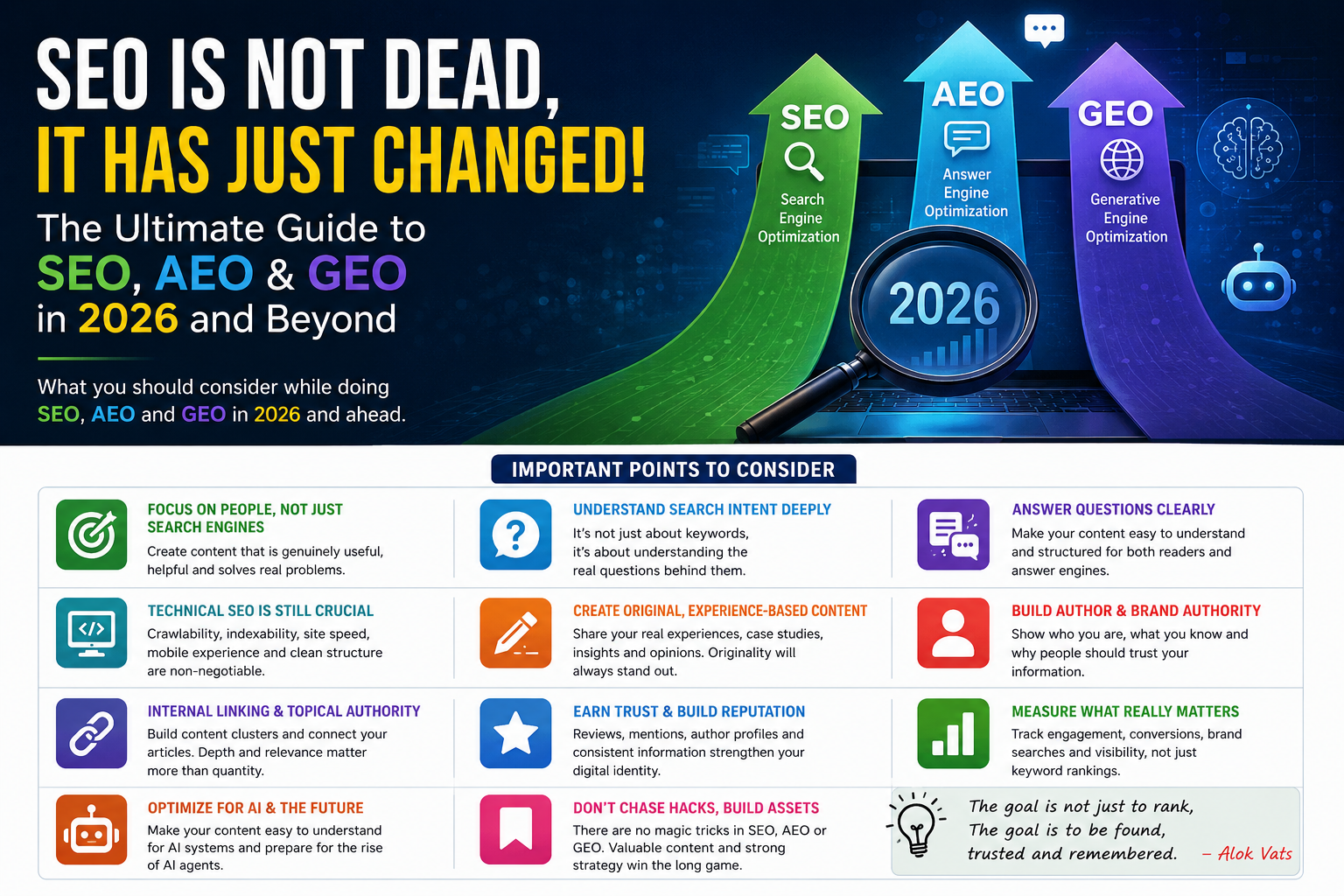
And remember to describe visual content properly. Like for this blog, take a look at this image:
Don’t upload an image called (one of the most common mistakes every second website owner do):
IMG_78291.jpg
and forget about it.
Give it a meaningful filename and relevant alt text.
17. Local SEO + GEO Can Be a Powerful Combination
For local businesses, this becomes even more interesting.
Suppose someone asks:
“Which is the best digital marketing agency near me?”
That isn’t a traditional ten-blue-links query.
The user wants recommendations.
This means local businesses need to maintain accurate:
- Business information
- Location details
- Contact information
- Business profiles
- Reviews
- Services
- Opening hours
- Website content
Consistency matters.
If your website says one thing and your business profile says something else, you are creating confusion.
18. Reviews and Reputation Matter
Imagine two companies.
Company A has a beautiful website but almost no online reputation.
Company B has a good website, hundreds of genuine reviews, useful content, active profiles and a visible team.
Which one would you trust?
Exactly.
SEO cannot be isolated from reputation anymore.
Your digital footprint includes:
- Your website
- Reviews
- Social profiles
- Author profiles
- Mentions
- Publications
- Community discussions
- Videos
- Interviews
- Business listings
This broader digital identity becomes particularly important in a world where AI systems can synthesize information from multiple sources.
19. Stop Chasing Every New “GEO Hack”
This is something I would strongly recommend. Every few months someone announces:
“New GEO trick to get cited by AI!”
Then somebody else announces:
“Put this special file on your website!”
Then another person says:
“Use this exact number of headings!”
Be careful.
Google’s own guidance is refreshingly straightforward: there are no special AI-only requirements or magical markup requirements for appearing in AI Overviews or AI Mode. Existing SEO fundamentals remain important.
Google’s May 2026 guidance also specifically addressed misconceptions around AEO/GEO and emphasized unique, valuable content rather than secret optimization tricks.
So my advice is simple:
Don’t chase hacks. Build assets.
20. Measure More Than Rankings
This is another major shift.
For years, we asked:
“What is my keyword ranking?”
Of course, rankings still matter.
But they are no longer enough.
You should also monitor:
- Organic impressions
- Organic clicks
- CTR
- Conversions
- Engagement
- Leads
- Revenue
- Branded searches
- Returning visitors
- Assisted conversions
- Visibility across search features
- Visibility in generative AI experiences where measurable
Google introduced dedicated generative AI performance reporting in Search Console in June 2026, initially rolling it out to a subset of sites. These reports are designed to provide visibility into impressions from generative AI features such as AI Overviews and AI Mode.
That tells us something important.
The measurement landscape itself is changing.
21. Don’t Measure Success Only by Traffic
Suppose your website receives 100,000 visitors.
But nobody contacts you.
Nobody subscribes.
Nobody buys.
Nobody remembers your brand.
Is that success?
I don’t think so.
A website receiving 10,000 highly relevant visitors who generate meaningful business can be far more successful.
So I would encourage businesses to think in terms of:
Visibility → Trust → Engagement → Conversion → Loyalty
Not just:
Ranking → Traffic
22. Prepare for AI Agents
This is perhaps one of the most interesting developments ahead.
Search is becoming more conversational.
But AI agents can potentially go further.
Instead of simply telling someone:
“Here are five hotels.”
an agent may increasingly help a person compare options, evaluate specifications, navigate websites and perform actions.
Google’s current generative AI guidance already discusses emerging agentic experiences, including systems that can act on behalf of users and interact with websites through interfaces such as the DOM and accessibility tree.
This means website owners should think beyond:
“Can Google rank my page?”
and begin asking:
“Can a machine reliably understand my business, products, services and processes?”
That requires clarity.
Clear information.
Clear navigation.
Accessible interfaces.
Accurate data.
Structured content.
And strong technical foundations.
23. Make Your Website Understandable
This may sound obvious, but it is becoming critical.
Imagine your website is being read by:
- A human
- Googlebot
- A search engine
- An AI system
- An AI agent
- A screen reader
Your website should make sense to all of them.
This means:
- Clear headings
- Logical navigation
- Descriptive links
- Textual information
- Accessible content
- Structured information where appropriate
- Consistent business information
- Clear calls to action
You don’t need to create a separate “AI version” of your website.
You need to create a better website.
24. Your Brand Is Becoming a Search Asset
This is something I believe will become increasingly important.
Suppose someone searches:
“SEO expert”
versus:
“Alok Vats SEO”
The second search demonstrates brand recognition.
A strong brand can generate searches that generic SEO never could.
This means you should not only optimize pages.
You should build your name, reputation and authority.
- Write.
- Speak.
- Publish.
- Share.
- Participate.
- Teach.
- Create videos.
- Attend events.
- Contribute opinions.
- Build relationships.
The internet should gradually develop an understanding of who you are and what you know.
25. Don’t Forget the Human Emotion
Now comes perhaps my favorite part. Technology keeps changing. Google changes. Algorithms change. AI changes. Search interfaces change.
But people don’t change as quickly.
People still want:
- Trust
- Simplicity
- Help
- Confidence
- Answers
- Convenience
- Authenticity
When someone visits your website, remember that there is a human being on the other side.
A person who may be confused.
A business owner who may be worried.
A customer who may be comparing you with someone else.
A student who may be trying to learn.
A parent who may be looking for guidance.
If your content can genuinely help that person, you are doing something right.
And frankly, this is the part of digital marketing I have always enjoyed the most.
SEO + AEO + GEO: My Practical 2026 Checklist
If I had to simplify everything we discussed into one checklist, this is what I would recommend.
SEO
☑ Make your website technically healthy.
☑ Ensure important pages can be crawled and indexed.
☑ Improve page experience.
☑ Conduct proper keyword research.
☑ Understand search intent.
☑ Optimize titles and headings.
☑ Improve internal linking.
☑ Build quality external references and links naturally.
☑ Create useful content.
☑ Keep important information in text.
AEO
☑ Identify the questions your audience actually asks.
☑ Answer important questions directly.
☑ Use descriptive headings.
☑ Create FAQ-style sections where genuinely useful.
☑ Explain complicated concepts simply.
☑ Provide definitions.
☑ Use concise answers followed by deeper explanations.
☑ Support claims with reliable evidence.
☑ Structure content logically.
GEO
☑ Build genuine topical authority.
☑ Publish original insights.
☑ Demonstrate first-hand experience.
☑ Make authorship clear.
☑ Strengthen your brand.
☑ Earn credible mentions.
☑ Maintain accurate business information.
☑ Create original research, examples and case studies.
☑ Publish useful multimedia content.
☑ Keep your website technically accessible to search systems.
☑ Don’t chase artificial “AI ranking” tricks.
And Finally… What Do I Think SEO Will Look Like Ahead?
If someone had asked me twenty years ago what SEO would look like in 2026, I am sure I would have got many things wrong.
That is the beauty of this industry.
It keeps changing.
I started my digital marketing journey in an era when link building was one of the hottest conversations in SEO. In fact the first job which I did, I had the designation of Link Builder, and we use to compete on the number of backlinks which we create on a daily basis. We use to call one of our colleague as LMG, Link Master GoGo, who was giving tough competition to me while building links.
Then came directories, especially Human Edited Directories.
Then more sophisticated link strategies.
Then algorithm updates.
Then content marketing.
Then mobile.
Then user experience.
Then semantic search.
Then AI.
And now we are discussing SEO, AEO, GEO and AI agents.
Sometimes I wonder whether we are actually changing the name of the game every few years.
But when I look closely, I realize something.
The fundamentals have not changed as much as we think.
Twenty years ago, the goal was to help a website get discovered.
Today, the goal is still to get discovered.
Twenty years ago, trust mattered.
Today, trust matters even more.
Twenty years ago, useful content mattered.
Today, useful content is becoming the differentiator.
The technology has changed dramatically.
The principle hasn’t.
The Future Belongs to Those Who Are Worth Finding
This is the conclusion I would like to leave you with.
Don’t build a website simply because you want Google traffic.
Don’t write an article simply because a keyword has search volume.
Don’t create 500 AI-generated articles because someone promised that you will get traffic.
Don’t chase every new acronym that appears on LinkedIn.
Instead, ask yourself some simple questions:
Am I genuinely helping people? Check this blog post of mine especially for this: Blog Now Live Forever (BNLF) Meet Experience – by IndiBlogger!
Do I know what I am talking about?
Can I demonstrate my experience?
Am I providing something original?
Can people trust me?
Is my website technically accessible?
Can both humans and machines understand what I am saying?
Would I be proud if someone shared this article with a friend?
If the answer is yes, you are already doing something very important.
You are building an asset.
And that asset can survive algorithm changes.
It can survive changes in search interfaces.
It can survive the rise of AI.
Because you are not optimizing only for an algorithm.
You are building authority with people.
And ultimately, that is what SEO, AEO and GEO should be about.
Not gaming the machine.
But making sure that when somebody needs what you know, your knowledge can be found, understood, trusted and remembered.
That, in my opinion, is the real future of search.
And after watching SEO evolve for more than two decades, I can confidently say one thing:
SEO is not dead.
It has simply grown up.
And 2026 may just be the beginning of its most interesting chapter yet.
A Small Note From Me
I have written and followed SEO through several different eras, and every era initially felt like the “end of SEO.”
It wasn’t.
The tactics changed.
The platforms changed.
The terminology changed.
But the need to connect the right person with the right information never disappeared.
So, if you are a blogger, entrepreneur, marketer or business owner reading this in 2026, don’t be afraid of the changes taking place around you.
Learn them.
Experiment with them.
Question them.
And most importantly, don’t stop creating.
Because even in an age where machines can generate information in seconds, there will always be tremendous value in something that machines cannot manufacture on their own:
your real experience, your perspective and your story.
Happy optimizing!
And yes…
keep blogging!
Leave a Reply