
If you’ve spent two decades in digital marketing, you don’t just observe change—you live through revolutions. What began as a mechanical, loophole-driven discipline has evolved into a sophisticated blend of technology, psychology, creativity, and data science.
I’ve seen it all—from the wild west of link building to today’s AI-driven, intent-first ecosystem. This blog is not just a retrospective; it’s a roadmap of how digital marketing matured—and where it’s headed next.
A 20-Year Journey Through Algorithms, Adaptation, and Audience-First Thinking
🧭 Introduction: From Tricks to Trust
Digital marketing didn’t evolve gradually—it transformed dramatically.
Over the past 20 years, we’ve moved from manipulating algorithms to understanding humans. What once worked effortlessly can now destroy a website’s credibility overnight.
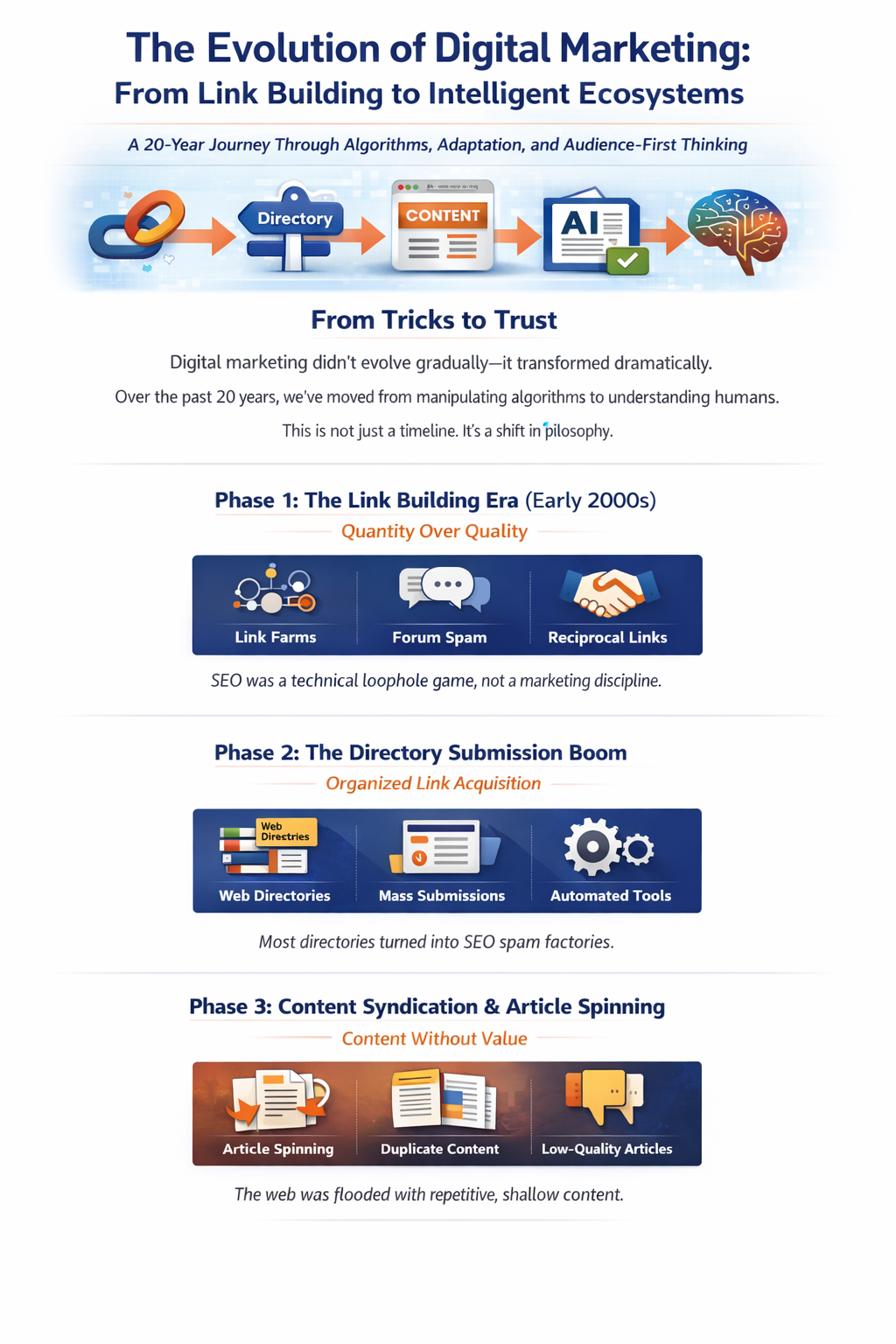
This is not just a timeline. It’s a shift in philosophy.
🏗️ Phase 1: The Link Building Era (Early 2000s)
🚀 Strategy Focus: Quantity Over Quality
In the early days, search engines relied heavily on backlinks. The result? A gold rush.
What Marketers Did:
- Built thousands of backlinks overnight
- Used forums, blog comments, and guestbooks
- Created link farms and PBNs
Reality Check:
Search rankings were easily manipulated. The system rewarded volume—not value.
Key Insight:
👉 SEO was a technical loophole game, not a marketing discipline.
📂 Phase 2: The Directory Submission Boom
📌 Strategy Shift: Organized Link Acquisition
As link spam grew, directories became the “cleaner” alternative.
Popular Tactics:
- Submitting sites to hundreds of directories
- Using automated tools for mass submissions
- Categorizing businesses for relevance
The Problem:
Most directories lacked real moderation and became spam hubs.
What Changed:
Search engines started ignoring low-quality directory links.
✍️ Phase 3: Content Syndication & Article Spinning
🧠 Strategy Focus: Scale Content, Not Value
“Content is King” became popular—but misunderstood.
What Marketers Did:
- Wrote one article
- Spun it into multiple versions
- Distributed it across hundreds of platforms
Outcome:
The internet became flooded with repetitive, low-value content.
Lesson:
👉 Content without originality is just noise.
⚡ Phase 4: The Algorithm Revolution (2011–2013)
💥 The Industry Reset
This was the moment everything changed.
What Happened:
- Low-quality content got penalized
- Spam backlinks lost value
- Websites disappeared from rankings overnight
Industry Impact:
- Businesses collapsed
- SEO agencies reinvented themselves
- Fear replaced blind execution
Key Shift:
👉 Search engines started prioritizing user experience over tactics
🛡️ Phase 5: The Disavow Era
🔍 Strategy Focus: Damage Control
Backlinks became risky.
New Actions:
- Auditing backlink profiles
- Removing toxic links
- Using disavow tools
The Irony:
The same links that boosted rankings earlier now caused penalties.
Lesson:
👉 Shortcuts always come with delayed consequences.
📚 Phase 6: The Rise of Quality Content (Mid-2010s)
🎯 Strategy Focus: User Intent
The industry matured.
What Changed:
- Long-form content gained importance
- Blogs became educational hubs
- Keyword stuffing disappeared
Winning Content Types:
- Guides & tutorials
- Case studies
- Thought leadership
Transformation:
👉 SEO became a blend of content + UX + intent
📱 Phase 7: Social Media & Brand Era
🌐 Strategy Focus: Visibility Beyond Search
Digital marketing expanded beyond search engines.
New Channels:
- Social platforms
- Video content
- Influencer collaborations
What Worked:
- Authentic storytelling
- Community engagement
- Real-time content
Key Insight:
👉 Brands became more important than rankings.
📊 Phase 8: Data-Driven Marketing
📈 Strategy Focus: Analytics & Insights
With advanced tools, marketers gained clarity.
Key Capabilities:
- User journey tracking
- Conversion analytics
- Heatmaps & behavior insights
Metrics Evolution:
- Traffic → Engagement
- Clicks → Conversions
- Leads → Lifetime value
Shift:
👉 Decisions became data-backed, not assumption-driven
🤖 Phase 9: The Present Era – Intelligent Marketing
🧠 Strategy Focus: Intent + AI + Experience
Today’s ecosystem is smarter, faster, and more human-centric.
🔑 What Defines Modern Digital Marketing?
1. Search Intent First
Understanding why users search—not just what they search.
2. AI & Automation
From content creation to campaign optimization.
3. User Experience (UX)
Speed, design, and usability directly impact rankings.
4. E-E-A-T
Experience, Expertise, Authority, Trust define credibility.
5. Multi-Channel Integration
SEO, social, paid ads, and email—all working together.
6. Content Depth
One powerful article > 50 average ones.
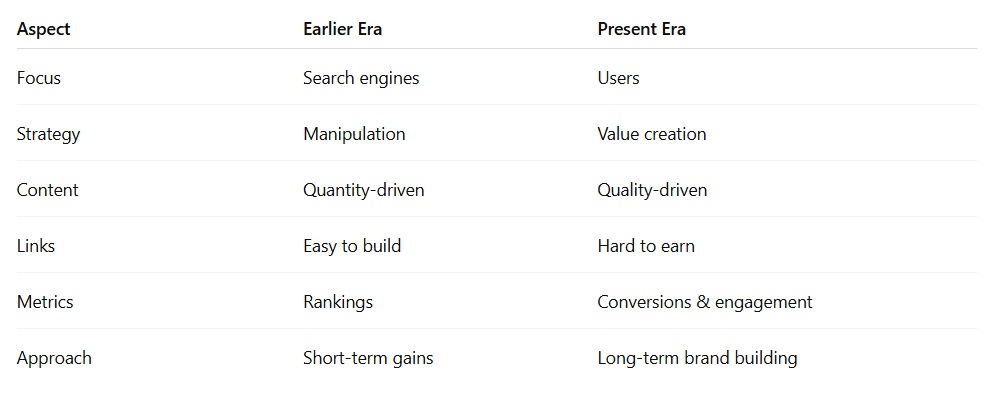
⚖️ Then vs Now: A Strategic Comparison
| Factor | Earlier Era | Modern Era |
|---|---|---|
| Focus | Algorithms | Users |
| Content | Quantity | Quality |
| SEO | Manipulation | Value |
| Links | Built easily | Earned naturally |
| Metrics | Rankings | Conversions |
| Approach | Short-term | Long-term |
🧠 Expert Takeaways (20 Years of Experience)
1. Every Shortcut Expires
If it’s easy, it won’t last.
2. Adaptability Wins
Those who didn’t evolve are no longer in the game.
3. Value is the Only Moat
Real value builds sustainable growth.
4. Marketing = Psychology + Technology
Understanding people matters more than understanding tools.
🔮 The Future of Digital Marketing
🚀 What’s Coming Next:
- Hyper-Personalization: Real-time tailored experiences
- Voice Search: Conversational queries rising
- AI Ecosystems: Campaigns run by intelligent systems
- Zero-Click Content: Information consumed without leaving platforms
- Community-Led Brands: Loyalty over reach
🏁 Conclusion: The Real Evolution
Digital marketing didn’t just change tactics—it changed purpose.
We moved from:
- Gaming algorithms
to - Serving humans
And that’s what defines success today.
💡 Final Thought
The future doesn’t belong to those who understand SEO.
It belongs to those who understand people.
Looking back, digital marketing has transformed from a technical loophole game into a discipline rooted in empathy, creativity, and intelligence.
The biggest shift isn’t in tools or algorithms—it’s in mindset.
Because at the end of the day, no matter how advanced technology becomes, one truth remains constant:
Marketing is not about algorithms. It’s about people.
Please do share your thoughts on the Evolution of Digital Marketing or any comment on this blog post of mine.
Leave a Reply