
There was a time when one of the biggest questions a B2B marketing manager had to answer was: “How much did we spend?”
Then came the next question: “What did we get for that spend?”
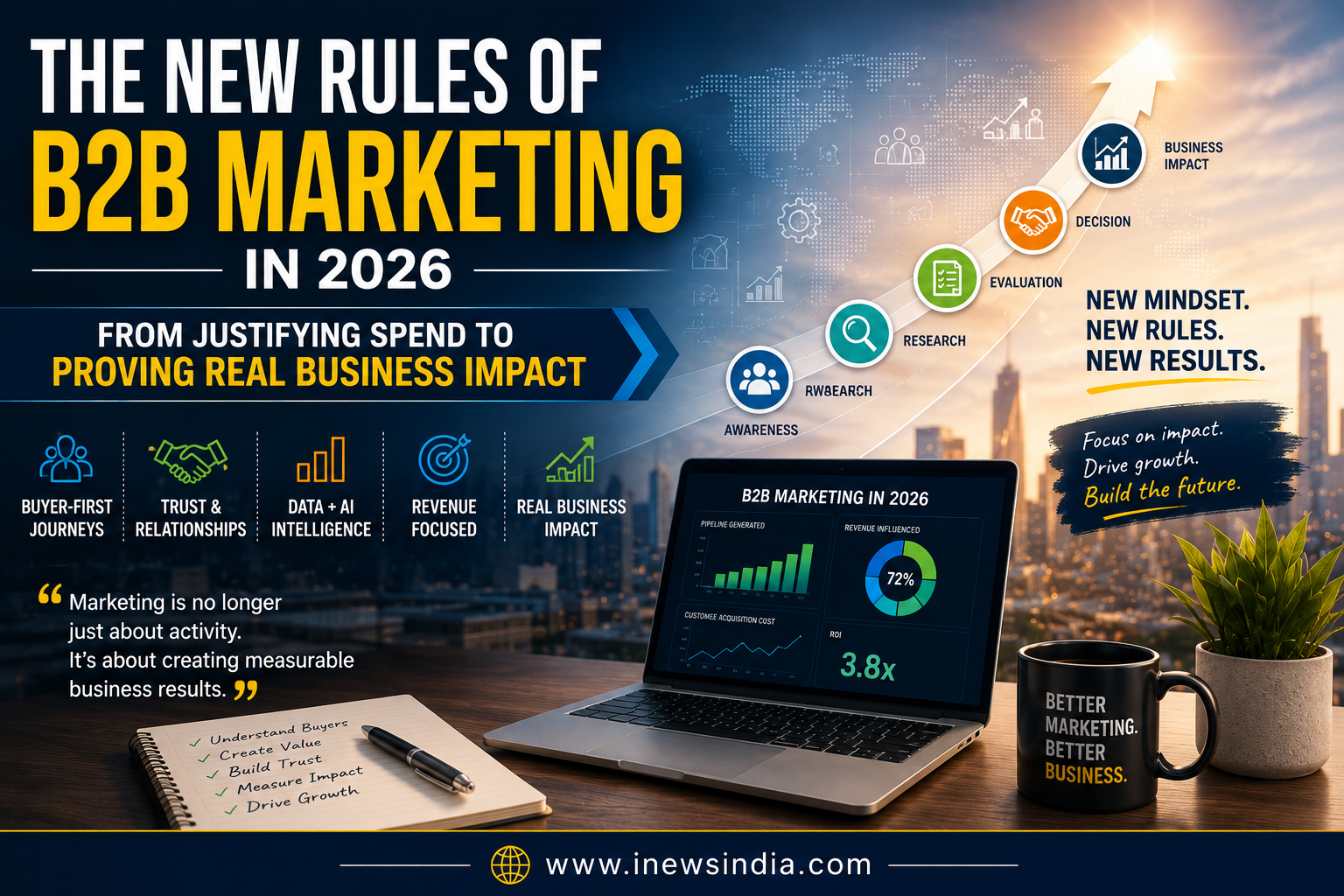
And today, in 2026, I believe the question has changed completely: “What business impact did marketing actually create?”
That is not just a change in terminology. It is a fundamental change in how B2B marketing is expected to work.
Having spent more than 20 years in the digital marketing industry, I have had the opportunity to watch this transformation from very close quarters. I have seen digital marketing move from being something that many businesses considered an experiment to becoming one of the most important components of their growth strategy.
I have seen SEO evolve from directory submissions and link building to sophisticated search ecosystems. I have seen companies become obsessed with website traffic. Then leads, then cost per lead, then marketing-qualified leads, then sales-qualified leads.
And now?
Revenue. Pipeline. Customer acquisition. Retention. Growth. Business impact.
And honestly, I think this is a very healthy change.
Because marketing should not exist simply to consume a budget.
Marketing should create value.
So, what exactly are the new rules of B2B marketing in 2026?
How has B2B marketing changed over the years?
Why are traditional marketing metrics no longer enough?
And what should B2B marketers focus on if they want to remain relevant in the years ahead?
In this blog on B2B Marketing in 2026, let me share what I have learned from more than two decades in digital marketing.
How Did B2B Marketing Used to Work?
Let’s go back a little. Before digital marketing became such an integral part of B2B growth, marketing was largely dependent on traditional channels.
- Trade shows.
- Print advertisements.
- Industry magazines.
- Direct mail.
- Telemarketing.
- Events.
- Sales representatives.
- Brochures.
- Corporate presentations.
- And, of course, the good old business card!
The marketing department would create campaigns, generate awareness and pass leads to sales.
The measurement was often relatively straightforward.
How many people attended the event?
How many brochures were distributed?
How many leads were generated?
How much did the campaign cost?
The conversation was largely about activity.
Then the internet changed everything.
The Digital Marketing Revolution Changed B2B Forever
When websites became important, businesses suddenly had a digital storefront. I still remember the early days of my career when I revamped a business of Immigration consultants with the help of their website and Google. That business was on the verge of closing down when I joined them as Digital Marketing Manager and within a months of time I was able to revive them again. So website was the first.
Then came search engines. Then SEO. Then email marketing. Then PPC. Then social media. Then content marketing. Then marketing automation. Then CRM integration. Then analytics. And, then suddenly, marketers could measure almost everything.
We could tell businesses:
- How many people visited the website.
- Where they came from.
- Which keywords they searched.
- Which pages they visited.
- How long they stayed.
- Which forms they completed.
- Which campaign generated the lead.
- How much the lead cost.
This was revolutionary.
I remember how exciting it was when we first started getting access to this kind of information.
Compared with traditional marketing, digital marketing felt almost magical. We could finally see data. But there was another problem.
We started becoming obsessed with the data we could easily measure rather than the business outcomes that actually mattered.
The Age of “More Traffic Is Better”
For quite some time, traffic became one of the most celebrated metrics in digital marketing.
A website received 100,000 visitors?
Fantastic!
Organic traffic increased by 40%?
Amazing!
A campaign generated 50,000 clicks?
Wonderful!
But then someone from the business would eventually ask:
“How much revenue did this generate?”
And suddenly the room became quieter.
Because traffic isn’t revenue.
Clicks aren’t revenue.
Impressions aren’t revenue.
Even leads aren’t necessarily revenue.
A lead can be:
- Unqualified.
- Too small.
- Outside your market.
- Not ready to buy.
- Looking only for information.
- A student.
- A competitor.
- Someone downloading a free resource without any purchase intention.
So we gradually moved from measuring activity to measuring quality.
And now we are moving toward something even more important: Business impact.
The New B2B Buyer Is Very Different
One of the biggest changes in B2B marketing has nothing to do with marketing technology.
It is about the buyer.
Today’s B2B buyer is more informed.
They have access to reviews.
They have access to competitors.
They can watch product demonstrations.
They can read customer experiences.
They can compare pricing.
They can download research.
They can ask colleagues.
They can search Google, Facebook, Instagram, ChatGPT, Gemini, etc. And increasingly, they can ask AI.
Gartner’s 2026 research found that 67% of B2B buyers prefer a rep-free experience, while 45% reported using GenAI during a recent purchase. Another Gartner survey found that buyers use an average of seven information sources during a purchase.
Think about what that means.
The salesperson may no longer be the first source of information.
Your website may be.
Your LinkedIn content may be.
Your customer reviews may be.
A podcast may be.
A YouTube video may be.
A case study may be.
A Google search result may be.
Or increasingly, an AI-generated answer may influence the buyer before your sales team ever speaks to them.
That changes everything.
Rule No. 1: Stop Thinking About Leads. Start Thinking About Buyers.
This is probably one of the most important changes in B2B marketing. For years, we talked about:
Lead Generation.
Today, I think we need to talk much more about:
Buyer Enablement.
A lead is a record in your CRM.
A buyer is a human being trying to solve a business problem.
There is a huge difference.
Suppose somebody downloads your “Ultimate Guide to Digital Transformation.”
You may call that person a lead.
But what does the person actually need?
Perhaps they are trying to reduce operational costs.
Perhaps their company is expanding.
Perhaps they are replacing an outdated system.
Perhaps their management has given them six months to transform a process.
Perhaps they are comparing three vendors.
Understanding this context is far more valuable than simply knowing that someone downloaded a PDF.
Modern B2B marketing should help buyers make better decisions and so become outstanding.
Rule No. 2: Marketing and Sales Can No Longer Work in Separate Worlds
I remember when marketing and sales were often treated almost like two different departments with two different languages.
Marketing would say:
“We generated 2,000 leads.”
Sales would respond:
“Only 20 of them were useful.”
Marketing would say:
“The campaign performed brilliantly.”
Sales would say:
“We couldn’t close anything.”
And then the blame game would begin. And then in India, not many people are even aware of the fact that Sales and Marketing are two entirely different units of a business. For them both works the same.
Fortunately, this model is becoming increasingly difficult to sustain.
Modern B2B marketing requires marketing and sales to work around the same commercial objectives.
They need to agree on:
- Ideal customer profiles.
- Target accounts.
- Buying signals.
- Lead quality.
- Pipeline stages.
- Revenue targets.
- Customer acquisition cost.
- Conversion rates.
- Sales cycle.
- Retention.
- Expansion opportunities.
Marketing should understand what makes a lead valuable and the sales should understand where the leads came from and what content influenced them.
The customer doesn’t care which department owns the journey.
Why should we?
Rule No. 3: Marketing Must Prove Its Contribution to Revenue
This is where the biggest shift has happened. Earlier, the marketing conversation was often:
“We spent ₹10 lakh and generated 5,000 leads.”
Today, the conversation should increasingly become:
“We invested ₹10 lakh, influenced ₹X crore in pipeline, generated ₹Y in revenue and improved customer acquisition efficiency by Z%.”
That is a much more powerful conversation. Of course, B2B attribution isn’t always simple.
A customer might:
- See your LinkedIn post.
- Search your brand on Google.
- Read three blogs.
- Watch a webinar.
- Visit your website.
- Speak to a colleague.
- Download a case study.
- Talk to your sales team.
- Attend a demo.
- Finally become a customer.
Which one of those generated the sale?
Probably not one.
The journey did. Hence the customer journey becomes very important.
Therefore, modern B2B measurement needs to move beyond simplistic last-click attribution.
Rule No. 4: Don’t Just Measure ROI. Understand Business Impact.
ROI is important. But sometimes even ROI isn’t enough.
Marketing can influence things that don’t immediately appear in a simple campaign report.
For example:
- Brand awareness.
- Category leadership.
- Customer trust.
- Sales cycle acceleration.
- Win rates.
- Customer retention.
- Cross-selling.
- Customer lifetime value.
- Employee advocacy.
- Organic search visibility.
- Direct traffic.
- Branded searches.
- Partner relationships.
LinkedIn’s 2025 B2B Marketing Benchmark found that 94% of surveyed B2B marketers considered trust critical to success, while its research also highlighted the growing influence of video, creators and customer/peer recommendations.
This is important.
Trust is not just a branding metric anymore.
It can influence whether someone enters your funnel in the first place.
Rule No. 5: Trust Has Become a Marketing Asset
Think about your own buying behavior. Suppose you are looking for a B2B service.
Company A has a beautiful website with dozens of generic marketing claims.
Company B has:
- Real customer stories.
- Expert articles.
- Industry insights.
- Client testimonials.
- Case studies.
- Videos.
- Recognized experts.
- Reviews.
- Transparent information.
Which company are you more likely to trust? I know which one I would choose.
And this is why I believe trust is becoming one of the most important currencies in B2B marketing.
The interesting thing is that trust cannot simply be purchased through advertising.
You can buy impressions.
You can buy clicks.
You can buy reach.
But you cannot simply buy credibility.
Credibility has to be earned. And honestly, it takes time to build that.
Rule No. 6: Content Marketing Has Moved From “More” to “Better”
There was a phase in digital marketing when publishing more content seemed like the answer to everything. Publish five blogs.
Then ten.
Then twenty.
Then fifty.
Create ebooks.
Create whitepapers.
Create infographics.
Create landing pages.
And keep publishing.
But today, with generative AI making content creation incredibly easy, the internet has an even bigger problem:
Too much average content.
Anyone can ask an AI tool to write:
“10 Benefits of Cloud Computing.”
Anyone can generate:
“Complete Guide to Digital Transformation.”
Anyone can create:
“Top 20 B2B Marketing Trends.”
So what differentiates your content?
Original thinking.
Your experience.
Your data.
Your case studies.
Your opinions.
Your mistakes.
Your customer stories.
Your proprietary research.
And the most importantly, your unique perspective.
Google’s current guidance around generative AI search emphasizes valuable, unique, non-commodity content rather than special “AI ranking hacks.” Google also states that existing SEO fundamentals remain foundational for its generative search experiences.
So the new rule is simple: Don’t create more content. Create more valuable content.
Rule No. 7: B2B Marketing Must Become More Human
This may sound strange.
B2B is supposed to be about businesses.
But businesses don’t buy anything.
People do.
A CTO buys.
A CMO buys.
A procurement manager buys.
A CEO buys.
A finance head approves.
A business owner signs the contract.
And all of them are human beings.
This is why I think B2B marketing is becoming more personal.
People want to know:
Who is behind the company?
They want to hear from experts.
They want opinions.
They want stories.
They want demonstrations.
They want to understand how other companies solved similar problems.
LinkedIn’s 2025 research found that video and influence are increasingly important in building trust in B2B, with 78% of surveyed B2B marketers using video and more than half planning to increase investment.
The message is clear: People trust people.
Rule No. 8: Your Employees Can Become Your Media Channel
This is another major change. Earlier, companies had corporate communication channels.
Today, employees can become powerful distribution channels themselves.
Think about a company where:
- The CEO shares industry opinions.
- The CMO shares marketing insights.
- The CTO explains technology.
- Sales leaders share customer lessons.
- Employees share their experiences.
Suddenly, the brand becomes much more human.
Instead of one corporate LinkedIn page broadcasting messages, you have dozens or hundreds of people creating authentic conversations around the brand.
This isn’t simply employee advocacy.
It is humanizing the brand.
And in a trust-driven B2B environment, that can be incredibly powerful.
Rule No. 9: SEO Is Still Important—But Search Has Changed
As someone who has spent a significant part of my career in SEO, I cannot talk about modern B2B marketing without discussing search. But SEO itself has changed. B2B buyers don’t only search traditional keywords anymore.
They ask questions.
They compare.
They research.
They use conversational queries.
And increasingly, they use AI-powered search experiences.
Google’s AI Mode is designed around more conversational exploration, follow-up questions and deeper research, while Google’s 2026 guidance says that traditional SEO best practices remain foundational to appearing in generative AI search experiences.
This is where I see SEO, AEO and GEO becoming part of B2B marketing.
SEO
Help search engines discover and understand your content.
AEO
Make your content useful as an answer to real questions.
GEO
Build content, expertise and authority that can be understood within generative AI experiences.
To know more about SEO, AEO and GEO, you should also read this blog post of mine: SEO Is Not Dead, It Has Just Changed! The Ultimate Guide to SEO, AEO & GEO in 2026 and Beyond!
The important thing is that these shouldn’t become three completely separate marketing departments.
They should be part of one intelligent content strategy.
Rule No. 10: Build a “Best Answer” Brand
Here is a concept I really like for modern B2B marketing:
Become the best answer in your category.
If someone asks:
“What is the best CRM for a growing SaaS company?”
Would your brand appear?
If someone asks:
“How can a manufacturing company reduce supply-chain costs?”
Would your content be useful?
If someone asks:
“What should a B2B company consider before investing in digital transformation?”
Would your experts have something valuable to say?
This is much bigger than ranking for keywords.
It is about becoming a source of knowledge.
And this is where your website, blog, LinkedIn presence, videos, podcasts, webinars, customer stories and expert profiles should all work together.
Rule No. 11: Don’t Treat AI as a Content Factory
AI is transforming B2B marketing. There is no doubt about that.
It can help marketers with:
- Research.
- Ideation.
- Content outlines.
- Personalization.
- Data analysis.
- Campaign optimization.
- Lead scoring.
- Customer segmentation.
- Sales enablement.
- Predictive analytics.
- Reporting.
But there is a dangerous temptation.
“Let’s use AI to create more content.”
I think that is the wrong question.
The better question is:
“How can AI help us create better business outcomes?”
That’s a completely different mindset.
Use AI to make marketers smarter.
Not simply faster.
Use it to identify patterns.
Use it to understand customers.
Use it to personalize experiences.
Use it to help sales teams.
Use it to analyze performance.
Use it to reduce repetitive work.
But keep human judgment at the center.
Rule No. 12: Personalization Needs to Become More Intelligent
B2B personalization used to mean:
“Hi John.”
That’s not personalization.
That’s a mail merge.
Real personalization means understanding:
- Industry.
- Company size.
- Business challenges.
- Buying stage.
- Role.
- Intent.
- Existing relationship.
- Previous interactions.
- Business priorities.
Imagine showing a CFO content about cost optimization while showing a CTO content about scalability.
That is useful personalization. The goal isn’t to make the customer feel that you know their name.
The goal is to make them feel that you understand their problem.
Rule No. 13: The Funnel Is No Longer a Straight Line
Traditional marketing taught us about the funnel:
Awareness
↓
Interest
↓
Consideration
↓
Decision
↓
Purchase
Simple.
But today’s B2B journey looks much messier.
A buyer may:
Search Google. See a LinkedIn post. Ask ChatGPT. Talk to a colleague. Watch YouTube. Read a Reddit discussion. Visit your website. Leave.
Come back two months later.
Download a report.
Attend a webinar.
Talk to sales.
Go silent.
Then suddenly contact you.
The journey is no longer linear.
It is an ecosystem.
Therefore, B2B marketing needs to create useful touchpoints throughout that ecosystem rather than trying to force every person through the same funnel.
Rule No. 14: Marketing and Customer Experience Are Becoming Connected
Marketing used to end when the sale happened. Today, that makes very little sense.
A bad onboarding experience can damage the brand. A great customer experience can create referrals.
A happy customer can become an advocate. A customer success story can become your best marketing asset. So modern B2B marketing should connect:
Marketing → Sales → Onboarding → Customer Success → Advocacy
The customer should experience one brand.
Not five different departments.
Rule No. 15: Stop Celebrating Vanity Metrics
This one might upset a few marketers!
But let’s be honest. If your campaign generated:
100,000 impressions, 10,000 clicks, 5,000 video views, and 2,000 likes…
but generated no meaningful pipeline…
Was it really a successful B2B campaign?
Maybe. Maybe not.
It depends on the objective.
If the objective was awareness, perhaps it did its job.
But if the objective was revenue generation (which is certainly the most), then those numbers alone don’t tell the story.
This is why I believe modern marketers need to clearly distinguish between:
Attention Metrics
- Impressions
- Reach
- Views
- Engagement
Marketing Metrics
- Leads
- MQLs
- SQLs
- Cost per lead
- Conversion rates
Business Metrics
- Pipeline
- Revenue
- Customer acquisition cost
- Customer lifetime value
- Win rate
- Sales cycle
- Retention
- Expansion
The closer your marketing dashboard gets to business outcomes, the more valuable your marketing conversation becomes.
Rule No. 16: Marketing Should Talk the Language of the CFO
This is one of the biggest career lessons I have learned. If marketing wants a bigger budget, it needs to speak the language of business.
Don’t just say:
“We need more budget for content.”
Explain:
“We need this investment because it is expected to influence this audience, support this pipeline and contribute to these business outcomes.”
Don’t say:
“We need a bigger SEO budget.”
Say:
“We are investing in organic visibility because it can reduce our dependency on paid acquisition, create long-term discoverability and contribute qualified opportunities.”
The difference is enormous. Marketing becomes a business investment, not simply a cost center.
Rule No. 17: Marketing Attribution Needs Patience
There is one more thing I would caution marketers about. Don’t expect every marketing activity to produce immediate revenue. Some activities create demand. Some capture demand. Some build trust. Some educate buyers. Some influence existing opportunities. Some strengthen the brand. Some help sales close deals. Some reduce future acquisition costs.
Therefore, attribution needs context.
The question shouldn’t always be:
“Did this blog generate a sale?”
It could also be:
“Did this blog contribute to the buyer’s decision?”
That is a much more mature way of looking at marketing.
Rule No. 18: Build Assets, Not Just Campaigns
A campaign starts. A campaign runs. A campaign ends.
But some marketing activities create assets that continue working.
A strong article. A research report. A case study. A video library. A customer testimonial. A podcast. A knowledge hub. A strong brand. An expert’s reputation. An organic search presence.
These assets can continue creating value long after the original campaign ends.
That is the kind of marketing I would invest in.
Rule No. 19: B2B Marketing Needs to Be Omnichannel—But Not Everywhere
There is a temptation today to say:
“We need to be everywhere.”
LinkedIn.
Instagram.
YouTube.
Facebook.
X.
Email.
Podcasts.
Webinars.
Google.
AI search.
And everything else. But being everywhere isn’t necessarily the answer.
Being relevant where your buyers spend their time is.
Find out where your audience researches. Where they ask questions. Where they seek recommendations. Where they consume industry information.
Then build a strong presence there.
Depth is often more valuable than being mediocre everywhere.
Rule No. 20: The New Marketing Question Is “So What?”
This may be my favorite rule. Whenever someone presents a marketing report, I would encourage leadership teams to ask:
“So what?”
Website traffic increased.
So what?
Engagement increased.
So what?
Leads increased.
So what?
Pipeline increased.
So what?
Customers increased.
So what?
Revenue increased.
Now we are talking.
Of course, every metric has a role. But marketing should eventually connect the dots.
So, What Are the New Rules of B2B Marketing in 2026?
If I had to summarize everything into a practical list, I would say:
1. Stop measuring only marketing activity.
Measure business outcomes.
2. Stop thinking only about leads.
Think about buyers and buying journeys.
3. Stop treating sales and marketing separately.
Build one revenue team.
4. Stop producing content just to fill a calendar.
Create content that solves real problems.
5. Stop chasing traffic.
Chase relevance.
6. Stop treating trust as a branding exercise.
Treat it as a growth asset.
7. Stop using AI only for content production.
Use AI to improve decisions and outcomes.
8. Stop relying on linear attribution.
Understand the entire customer journey.
9. Stop chasing every platform.
Focus on where your buyers actually are.
10. Stop asking, “How much did we spend?”
Start asking, “What business impact did we create?”
What Has 20 Years in Digital Marketing Taught Me?
If I look back at my own journey, the most interesting thing isn’t how many tools have changed.
It is how much the thinking has changed.
Twenty years ago, we were often trying to convince businesses that digital marketing deserved a place at the table.
Then digital became mainstream.
Then everybody wanted digital.
Then everybody wanted measurable digital.
Then everybody wanted performance.
And now everybody wants business impact.
I think this is exactly where marketing belongs. Marketing should not have to apologize for spending money. But marketing should be able to explain why that investment matters.
There is a huge difference. A marketing budget is not automatically an expense. If done correctly, it is an investment in:
Demand.
Trust.
Relationships.
Brand.
Pipeline.
Customers.
Revenue.
And ultimately:
Growth.
The Future of B2B Marketing Will Be Human + Data + AI
Sometimes people ask me whether AI will replace marketers. I don’t think that is the right question.
The better question is: Which marketers will use AI to become better marketers?
Because the future, in my opinion, isn’t human versus AI.
It is: Human + Data + AI.
Humans bring:
- Creativity.
- Empathy.
- Experience.
- Judgment.
- Relationships.
- Storytelling.
- Strategy.
Data brings:
- Evidence.
- Patterns.
- Measurement.
- Insights.
AI brings:
- Speed.
- Scale.
- Analysis.
- Automation.
- Personalization.
Put all three together and marketing becomes much more powerful.
And Finally… B2B Marketing Is Still About People
After all these years, I keep coming back to one simple thought. We have changed the technology.
We have changed the platforms.
We have changed the terminology.
We have changed the dashboards.
We have changed the way people search.
We have changed the way buyers research.
We have introduced AI into almost every part of the marketing process.
But one thing hasn’t changed.
A person still has to trust another person before making an important business decision.
And that is why I don’t think the future of B2B marketing is going to be completely automated. I think it will become more human.
Because when information becomes abundant, trust becomes scarce. When content becomes cheap, expertise becomes valuable.
When AI can produce thousands of articles, original experience becomes a differentiator.
When everyone can advertise, credibility becomes a competitive advantage.
And when every marketer has access to similar technology, the quality of thinking becomes the difference.
That is perhaps the biggest lesson I have learned after more than 20 years in digital marketing.
The tools have changed.
The algorithms have changed.
The platforms have changed.
But the fundamental objective of marketing remains the same:
Understand your customer.
Solve a real problem.
Create value.
Build trust.
And demonstrate that your work is making a difference.
So, if you are still preparing your B2B marketing report by saying:
“We spent ₹X and generated Y leads…”
maybe it is time to change the conversation.
Start saying:
“Here is the business problem we wanted to solve.”
“Here is what marketing did.”
“Here is how buyers responded.”
“Here is the pipeline we influenced.”
“Here is the revenue impact.”
And most importantly:
“Here is what we learned, and here is what we will do better next.”
Because that, in my opinion, is the new rule of B2B marketing.
Don’t just justify your marketing spend.
Demonstrate the business impact.
And perhaps that is the biggest evolution I have seen in B2B marketing during my journey of more than two decades.
Frequently Asked Questions About B2B Marketing in 2026
What is B2B marketing in 2026?
B2B marketing in 2026 is increasingly focused on helping buyers discover, understand, evaluate and trust a business before they engage with sales. It combines digital channels, content, SEO, AEO, GEO, social media, AI, data, personalization and revenue-focused measurement.
How has B2B marketing changed over the years?
B2B marketing has evolved from traditional advertising, events, direct sales and lead generation toward digital-first, buyer-centric and data-driven marketing. Today, businesses increasingly focus on customer experience, trust, pipeline, revenue attribution and measurable business impact.
Why is business impact more important than marketing spend?
Marketing spend only tells you how much money was invested. Business impact shows what that investment achieved. Modern B2B marketers increasingly need to connect marketing activity with pipeline, revenue, customer acquisition, retention, sales efficiency and growth.
How is AI changing B2B marketing?
AI is changing B2B marketing through research, content assistance, personalization, analytics, automation, predictive insights and buyer research. However, AI should complement human expertise rather than replace strategic thinking, creativity, experience and judgment.
What role does SEO play in B2B marketing in 2026?
SEO remains important because B2B buyers still use search to research companies, products, services and solutions. However, SEO increasingly needs to work alongside conversational search, AEO and GEO as search experiences become more AI-driven. Google says its generative AI search experiences continue to rely on foundational SEO practices.
What is AEO in B2B marketing?
AEO, or Answer Engine Optimization, focuses on making content clear, useful and structured so that it can effectively answer the questions buyers ask through search and answer-oriented experiences.
What is GEO in B2B marketing?
GEO, or Generative Engine Optimization, broadly refers to improving the visibility and usefulness of a company’s content, expertise and brand within generative AI-powered discovery experiences. It should not be treated as a collection of secret AI-search tricks; Google’s guidance emphasizes valuable, unique content and foundational SEO.
What should B2B marketers measure in 2026?
B2B marketers should look beyond impressions and clicks and measure metrics such as qualified pipeline, revenue contribution, customer acquisition cost, conversion rates, sales-cycle impact, customer lifetime value, retention, expansion and other business outcomes relevant to their objectives.
A Final Thought
Maybe the biggest change in B2B marketing isn’t technological at all.
Maybe it is this:
Marketing has finally been asked to speak the language of business.
And I think that’s a good thing.
After all, if marketing is helping a business grow, why should we be afraid to measure it?
The future of B2B marketing isn’t about spending more.
It is about creating more value from every rupee, every idea, every interaction and every relationship.
That is the new game.
And I, for one, am looking forward to playing it.
Leave a Reply